


To Taos
Okay, when I left off last time, I had the Ancestral Puebloans leaving their Grand Pueblos and, for reasons still mysterious, moving south. They discovered various places where agriculture was at least possible (water is always a problem in New Mexico) and which were, at the same time, defendable. You want to be able to grow food, but you also don’t want to have local raiders swing by and take it all afterwards.
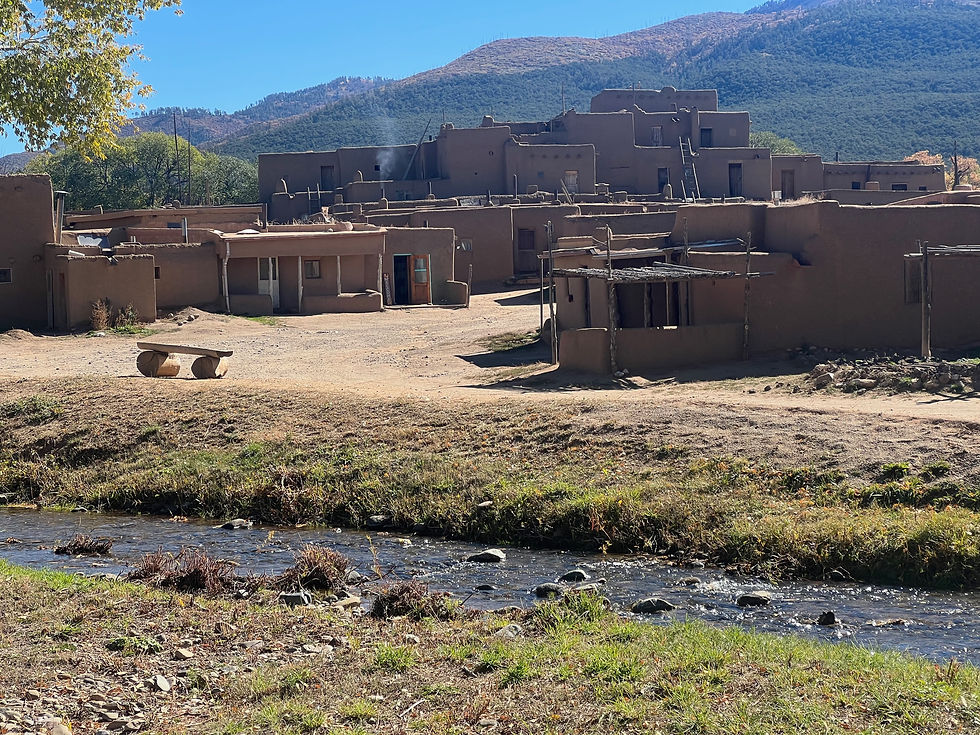
Thus it is that they moved to a variety of places, many of which are still inhabited today--viz.: Acoma Pueblo, Cochiti Pueblo, Isleta Pueblo, Jemez Pueblo, Laguna Pueblo, Nambe Pueblo, Ohkay Owingeh, Picuris Pueblo, Pojoaque Pueblo, San Felipe Pueblo, San Ildefonso Pueblo, Sandia Pueblo, Santa Ana Pueblo, Santa Clara Pueblo, Santo Domingo Pueblo (Kewa), Tesuque Pueblo, Zia Pueblo, Zuni Pueblo, Hopi Tribe, Fort Yuma–Quechan Tribe, and...of course...Taos Pueblo. (1)
About the photos: First, the remains of an ancient church just outside the Pueblo. This is what’s left of the San Geronimo Church which was destroyed by the U.S. Army in 1847 after a brief revolt in the area. It is said that hundreds of locals fled to the church but that the army used cannon against it, killing almost everyone inside.
Second, a drum and craft shop in one of the houses at the Pueblo. Martha took this photo during our visit. You can see me looking a bit bedraggled in the mirror on the right center of the image. Martha looks great, however.
Third, and nothing to do with the story, but I like it, here’s Martha laughing at her husband a while back. Doubtless I had just said something really witty. Or maybe not. Who knows?
At Taos, as at the other locations, the Pueblo peoples lived out their lives. Doubtlessly there were good times and bad, feasts and famines, wars and peace...unto everything there is a season. There was also trade. Taos was an important point along the trade routes of Rio Grande peoples and the Indians of the Great Plains. If things had been undisturbed, who knows what that might have meant in the long run? More than one great city has start as a trading post.
But, alas, things were not left alone. In 1540, Spanish conquistadors arrived in Taos -- members of Francisco Vázquez de Coronado’s expedition to find the Seven Cities of Gold -- and announced that from hence forward, this was land under the King of Spain. Also, everyone had to be Christian.
This was a disaster...for everyone. For the conquistadors as much as the local people. The reason for this has to do with what social scientists call “Macroparasitism” and the environmental realities of Northern New Mexico.
Here’s the thing: in this case, in the political sense, macroparasites are people. They are the elites in society who do not toil, neither do they spin. They live on the labor of others. They are the aristocrats, the kings, the queens, the priests, and so on that you find in every society.(2)
The problem is you can have macroparasites so long as you can afford them. Or, to put it another way, so long as someone in the society produces enough food, fuel, clothing, and labor that everyone can eat, be warm, and be clothed. Once that is not the case, then everything changes.
Now, the conquistadors came to New Mexico expecting to be able to do what they had done in Mexico, and Peru, and before that, in Spain itself (where, in the south at least, the peasantry was often formed of conquered Muslims). They expected to be able to walk in, take over the country, and use local people as the local labor who would grow food, carry water, hew wood, work in the vineyards, and all the rest of it. Then they, as the victors, would be able to sit back and live off their peasants’ work.
This, of course, offends us in our modern sensitivities, but we should keep in mind that this was quite typical for the time. It had been since the Neolithic. It was how elites came into being and gained (if did not earn) their daily bread. They came, they conquered, and then they loafed. Standard Operating Procedure all around...and it was true for our own ancestors as it was for everyone else.
But, Spain was well-peopled with industrious Muslims and others who could be made to work the fields. Mexico had lots of indigenous folks and well-watered fields. Peru was cold and mountainous, but the local people had long before figured out how to support dense populations and intensive agriculture in the highlands. You could have a European-style empire in those areas.
None of that was true of New Mexico. It was cold. It was dry. Populations were small, and often mobile. Agriculture was hit or miss. And, as a result, there simply weren’t enough resources to support an aristocracy in the European sense. Or, in other words, the peasantry could not grow enough food to feed itself *and* a population of priests and nobles.
This should have been obvious to anyone who was looking at the situation. But, for reasons known only to themselves -- maybe because they simply couldn’t conceive of a society ordered in any other way-- the conquistadors and those who followed them attempted to build a world in which they were an extractive aristocracy, and everyone else was a peon.
Except the environment would not support that. And soon the supposed peons found they had a choice. Either continue as they were, and inevitably starve. Or else...
Or else...
Take desperate...but maybe inevitable...measures.
More to come.
Footnotes:
1. An aside, there is actually one Pueblo in Texas, Ysleta del Sur Pueblo, which is located in what is now El Paso, Texas. Inhabited by the Tigua people, Ysleta was founded by refugees from the Pueblo Revolt of 1680 (more about which later). They fled very far south and sought protection from the Spanish authorities. They’ve been there ever since, though it has taken them years to establish recognition as an official Native American tribe. They really only achieved that valued status in the late 1980s. See “Ysleta del Sur Pueblo,” Wikipedia, https://en.wikipedia.org/wiki/Ysleta_del_Sur_Pueblo, and “The Ysleta del Sur Pueblo,” https://www.ysletadelsurpueblo.org/.
2. Not throwing stones. In a sense, I am a macroparasite myself. After all, it isn’t like I’m out hoeing potatoes or growing corn sitting out here in my Casita.
Text and photos one and three: Copyright©2026 Michael Jay Tucker. Second photo: Copyright©2026 Martha Trudeau Tucker
Care to help out?
I provide these blog postings for free. That’s fine and I’m happy to do so. But, long ago and far away, I was told that if you give away your material, that means you don’t really think it has any value.
So, to get beyond that, I’ve decided to make it possible for you to leave me a “tip” for my posts.
If you like what I write or the videos I produce, and feel you could make a small contribution to support my efforts, please go here:
That will take you to a Gumroad page where you’ll have the option of leaving me a few pence by way of encouragement.
Again, I don’t mind if you don’t. I just want to provide you with the option so that I won’t feel quite so much like I’m just tossing my works into the wind.
Either way, thanks hugely for dropping by the blog :-)
~mjt
#StampOutEnnui #MichaelJayTucker #MarthaTucker #MarthaAndMichaelChronicles #StompEnnuiLikeItWasABug #explosive_cargo #Xcargo #StampOutEnnui #MichaelJayTucker #MarthaTucker #MarthaAndMichaelChronicles #StompEnnuiLikeItWasABug #explosive_cargo #Xcargo #Saint_Michael #Michael_The_Archangel #NewMexico #Taos #Albuquerque #SantaFe #Kiva_fireplace #Ski_Area #Taos_Ski_Area #Nicolai_Fechin #Fechin_House #Eya_Fechin #Taos_Art_Museum #Vietnam_Veterans_Memorial_(New_Mexico) #Angel_Fire #Eagle_Nest #Taos_Pueblo


Comments